Excalidraw
A shared Excalidraw drawing per chat, opened in the Artifacts side panel.
Excalidraw is an open-source, browser-based whiteboard for sketching diagrams that look hand-drawn: boxes, arrows, text and freehand strokes, stored as a scene you can share or keep in the browser. The editor is published as a React component with documentation; this plugin embeds it in Open-WebUI's Artifacts panel and keeps one scene per chat.
| File | What it is |
|---|---|
function.py |
The Filter: serves the editor at /excalidraw/view/<chat_id> (mounted with the routes library) and appends it to replies so the panel opens. |
tool.py |
The Tool: lets the model show, read and change the drawing. |
shared.py |
In front of both, imported with from shared import ...: constants, the versioned scene on top of the chat_data library (a drawing lives in its chat's metadata under excalidraw) and the element helpers. |
templates/viewer.html |
The editor page, embedded in the bundle and never served raw: function.py reads it with plugin_template_text() and renders it at /excalidraw/view/<chat_id> for a signed-in user who can write to the chat, filling in a short-lived token. |
config.yaml |
assets_url: ${EXCALIDRAW_ASSETS_URL:-}: where the editor's files are, read from the Open-WebUI container's environment. Empty means esm.sh. |
self-host/ |
A pinned build script that produces the editor's files for you to host yourself (see below). Not part of the deployed plugin. |
The function is global and is the parent of the tool: enabling it installs the excalidraw Tool (public), disabling or deleting it removes it. By default the editor's code (React, Excalidraw) loads from esm.sh in the user's browser; to run with nothing from the internet, host it yourself.
Every route requires a signed-in user (the routes library). The editor page opens only for a user who can write to the chat (chat_id: WritableChat). Its API is called from the sandboxed panel, so it does not rely on cookies: it takes a short-lived token that is tied to the chat and handed out only on that signed-in page load; there is no permanent link. The page itself needs the session, which inside the panel means the setting below (libraries explains why for any plugin).
Valve (Admin Panel > Functions > Excalidraw): SESSION_TOKEN_HOURS.
Requirement: iframe Sandbox Allow Same Origin
On a default Open-WebUI the editor answers 401 ("Sign in to Open-WebUI first.") inside the panel. The Artifacts panel is a sandboxed iframe. Unless the user's iframe Sandbox Allow Same Origin setting is on, the panel sends no cookies at all, so the editor page (not only its API) cannot tell who is signed in. Open-WebUI v0.13.4 ships with the setting off. Found on a real Open-WebUI by the screenshot run.
To make it work, turn the setting on:
- for everyone: Admin Settings > General > Default Interface Settings, or the container variable
DEFAULT_INTERFACE_SETTINGS='{"iframeSandboxAllowSameOrigin": true}'. A user's own setting still wins; - or for one user: Settings > Interface > iframe Sandbox Allow Same Origin.
Know what it costs. The setting applies to every artifact, not only this one. With it on, the script in any HTML a model produces runs with Open-WebUI's own origin, so it can read the sign-in token Open-WebUI keeps in the browser and call the API as that user. This is an Open-WebUI permission that no plugin can narrow. Use this plugin only on an instance where you trust what the models put into artifacts.
It is the same setting, and the same cost, as Inline Visualizer (its upstream README says so too): an instance that already runs it for live rendering has already accepted it, and Excalidraw adds nothing to it.
The plugin keeps the requirement on purpose rather than working around it (issue #6). A token in the iframe's address would be written into the chat's stored HTML and would have expired by the time an old chat is reopened; a public page that asks the parent window for a credential needs Open-WebUI to answer, which it does not today.
Self-hosting the editor
Out of the box the user's browser fetches the editor from esm.sh, a public CDN: it needs internet access, trusts esm.sh to serve the code (there is no integrity check), and tells esm.sh the user's IP and the Open-WebUI origin. To load everything from a host you run instead, so the page needs nothing from the internet:
- Build the files (needs bun and network access once; the versions are pinned in
self-host/package.jsonandbun.lock):
cd self-host && ./build.sh /srv/excalidraw-assets
This writes editor.js (React, ReactDOM and Excalidraw in one module), the code-split chunks it loads on demand (languages, diagram conversion), index.css and Excalidraw's fonts, about 21 MB in all (mostly one CJK font, fonts/Xiaolai, which you can delete: those characters then use system fonts).
- Serve that folder from any static web server, with an
Access-Control-Allow-Origin: *header. The editor runs in Open-WebUI's sandboxed Artifacts iframe, whose origin is opaque, so its module and font requests are cross-origin. For nginx:
location /excalidraw-assets/ {
    alias /srv/excalidraw-assets/;
    add_header Access-Control-Allow-Origin "*" always;
}
- Tell the plugin where it is, with an environment variable on the Open-WebUI container:
EXCALIDRAW_ASSETS_URL=https://static.example.com/excalidraw-assets(or a path such as/excalidraw-assetsif it is served from the same host). It is read when the plugin loads, not when it is deployed, andowpp check excalidrawlists it.
The page then contains no esm.sh at all. To check, open the editor with the browser's network tab showing, or block esm.sh and confirm it still loads. A value that is not a plain http(s):// URL or path (quotes, spaces, angle brackets) is ignored with a warning and the page falls back to esm.sh.
This host is outside Open-WebUI, so it is yours to keep up: its files are public (they are the editor's code, with nothing of anyone's in them), and to upgrade Excalidraw you change EXCALIDRAW_VERSION in shared.py and the versions in self-host/package.json together (a test checks they agree), rebuild, and replace the folder.
Test
owpp check excalidrawbundles it exactly as the deploy does, compiles it and lists names it uses but never defines (the function and any tool it embeds).owpp bundle excalidraw out.pywrites the deployed code to read or diff.owpp test excalidrawrunstests/against a mock Open-WebUI (docs/testing.md).- On a live Open-WebUI, with iframe Sandbox Allow Same Origin on: open a chat and ask the model to draw something: the editor opens in the Artifacts panel and edits survive a reload. With
EXCALIDRAW_ASSETS_URLset, the network tab shows every file coming from your host.
Deploy
- Function type: filter (global).
owpp deploy --only excalidraw --dry-run, then without--dry-run. A single-plugin deploy never prunes.
Screenshots
Taken on Open-WebUI 0.13.4 on 2026-11-22 by tools/screenshots/run.py (how).
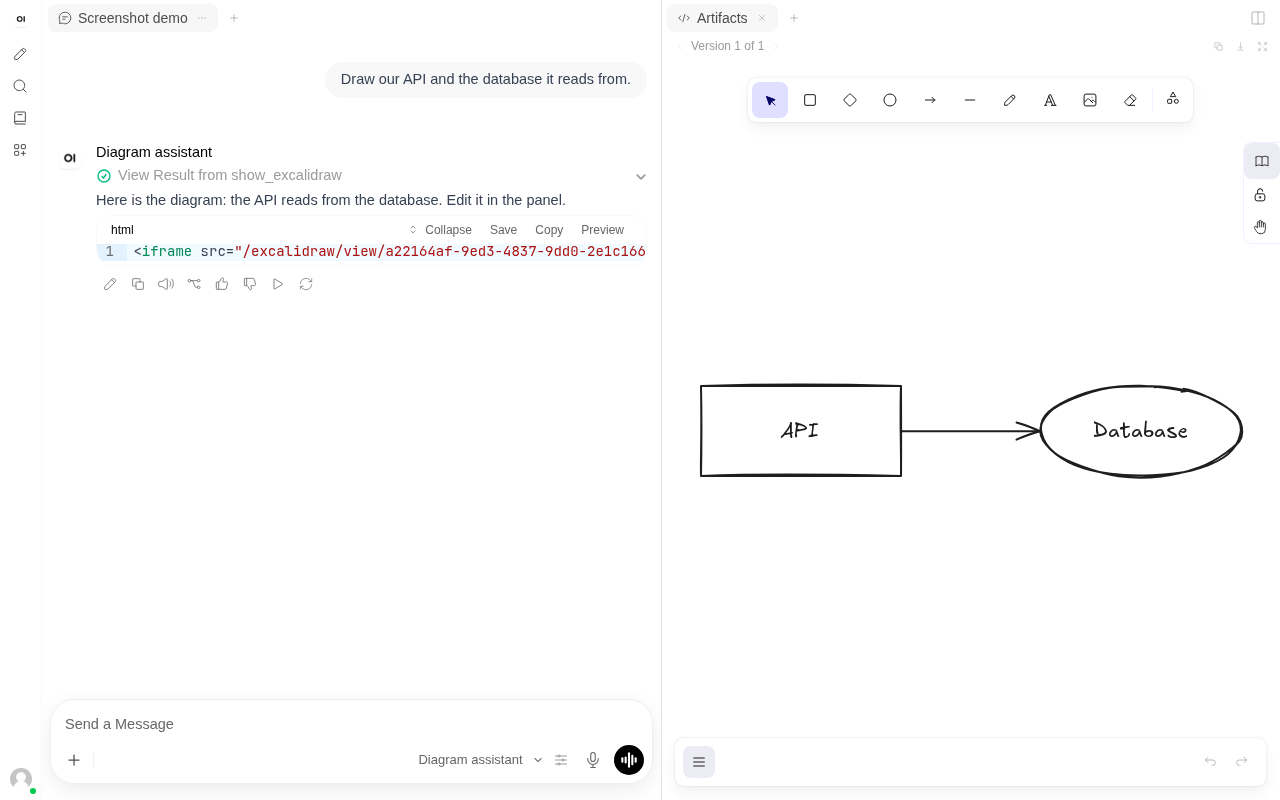
The model called show_excalidraw; the filter added the editor to the reply, and it opened in the Artifacts panel with the drawing.
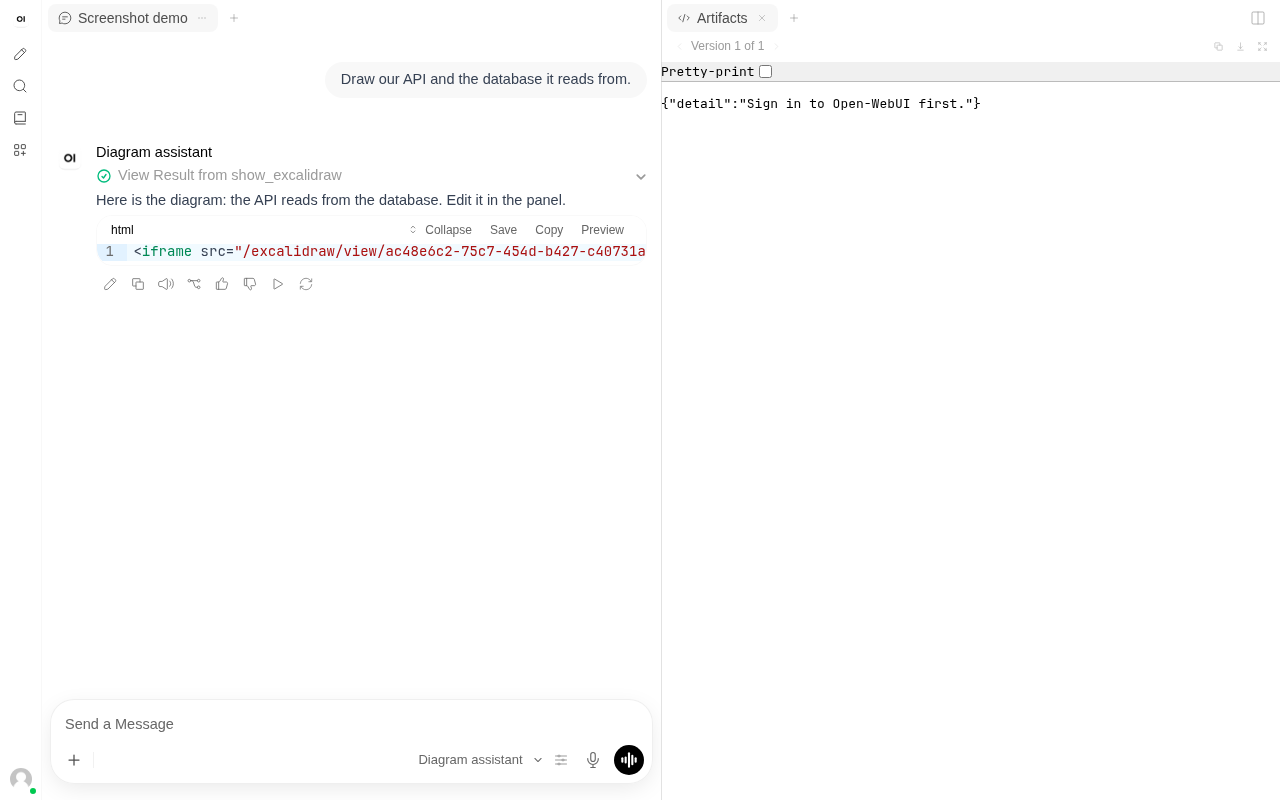
Known limitation: with "iframe Sandbox Allow Same Origin" off, Open-WebUI's default, the editor page gets no session and answers 401.
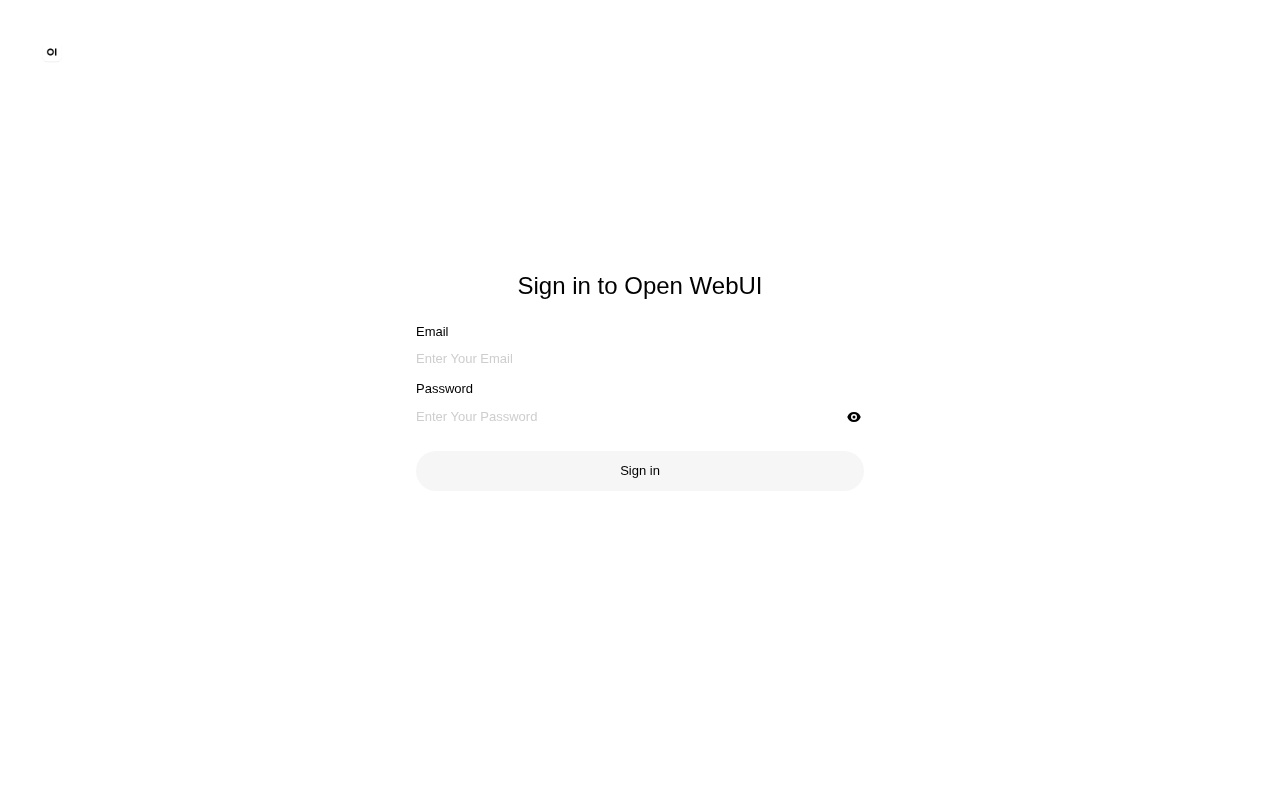
Signed out, the editor's address sends the browser to Open-WebUI's sign-in page, with a redirect back to the editor.