Adapted from Theme Designer Pro 1.22.0 and its Launcher 2.1.2 by G30, under the MIT licence (the notice is in NOTICE.md). It does what the original does; what changed is where the code lives and what owpp does for it, all listed below in How owpp broke it down.
Theme Designer Pro
Themes the whole of Open-WebUI for every user: a palette in Open-WebUI's own grey steps, accents, gradients, animated Canvas FX backgrounds, frosted glass surfaces, pictures behind pages and on the sign-in page, and custom CSS, designed in a page of its own at /api/v1/theme-designer. Saves reach every open page live, and the theme is there from the first paint, the sign-in page included. With Allow Personal Themes on, each user designs a theme of their own that only they see.
Enabling the function installs two things, and disabling it removes them:
- the Theme Designer Pro Launcher tool: in a chat, it builds a theme someone describes ("make my chat a koi pond") and shows it as a card with a live preview and Apply, or opens the designer inside the chat;
- the theme-designer-pro skill, with its references and templates, which tells the chat model how to design a theme and write a new animation.
It is the largest example in this repository, chosen for that: a 1.3 MB, 21,000-line single file, kept working exactly as its author wrote it while it was broken into the plugin format.
Valves
The function's, in Admin Panel > Functions > Theme Designer Pro > Valves. Every one has a test (tests/), named in the test catalogue.
| Valve | Default | What it does |
|---|---|---|
enable_canvas_fx |
on | Canvas FX animations; off hides the tab and serves every theme without its script. |
calm_chat_column |
off | Animations fade behind the chat, each by its own Center Calm. |
enable_custom_css |
on | The Style Overrides tab. |
enable_gradient_builder |
on | The Gradient tab. |
enable_ai_consultant |
on | The AI Consultant: a description in words, a palette from a model on the instance. |
enable_theme_update_checks |
on | Update checks for installed themes. |
enable_community_themes |
on | The Community Themes browser. |
enable_auth_page_theming |
on | Theming the sign-in pages; off serves every sign-in flag off. |
draft_mode_default |
off | The designer opens in Draft mode. |
show_in_admin_settings |
on | A Themes tab in the Admin part of Settings. |
show_in_admin_panel |
off | A Themes page in the Admin Panel's top bar. |
allow_personal_themes |
off | A personal theme for every user, from their own Settings. |
auto_sync |
off | Skip the Selective Sync dialog. |
sidebar_transparency |
opaque | opaque, translucent (frosted) or transparent sidebar. |
overlay_transparency |
opaque | opaque or translucent settings dialog and menus. |
enable_canvas_api_access |
off | Gives every animation each viewer's token. Leave it off unless you audited every script. |
enable_url_import |
on | The Load from URL controls. |
allowed_import_domains |
empty | Domains the designer may fetch from; empty is any. |
designer_url |
/api/v1/theme-designer |
Where the designer is served (kept under /api/v1). |
ai_consultant_model |
empty | The model the AI Consultant asks; empty is the task model. |
The Launcher's, in Workspace > Tools > Theme Designer Pro Launcher > Valves: designer_url (must match the function's), background_animations, model_written_animations, model_written_css, canvas_catalog_url, iframe_height, iframe_scale.
config.yaml has three limits of one worker, each settable from the Open-WebUI container's environment: TDP_SSE_MAX_CLIENTS (8192 live-update streams), TDP_SSE_HEARTBEAT_SECONDS (15) and TDP_CONSULT_INTERVAL_SECONDS (3). The defaults are the original's numbers.
Requirements
- Open-WebUI 0.13.4 or newer (the original's
required_open_webui_version). - iframe Sandbox Allow Same Origin, for the Launcher's Apply and for the designer inside a chat: without it, the chat's frame has no origin and the browser sends the designer no sign-in.
plugin.yamlsays so (requires:), andowpp deploywarns when it is off. Turn it on per user under Settings > Interface, or for everyone under Admin Settings > General > Default Interface Settings. It applies to every artifact, not only this plugin's: HTML a model writes then runs with Open-WebUI's origin and can act as the user, so turn it on only where what models put into artifacts is trusted (the cost, in full). - Live updates stream from the function: behind nginx,
proxy_buffering off;for/api/v1/theme-designer/events.
How owpp broke it down
This part is written for G30, the original's author, and for anyone adapting a function this size: what we did to your code, why, and how we checked that it still does what yours does.
The short version
Your function is three things in one file: the Python that runs on the server, about 1.1 MB of HTML, CSS and JavaScript that it serves, and two copies of other people's code (the Shared Assets Protocol and its live-reload add-on). owpp keeps each kind in its own place:
| The original | This plugin | |
|---|---|---|
| Python | about 3,900 of its 21,076 lines, between the strings | function.py: 3,718 lines, only Python |
| The designer page | one 943 KB raw string in _build_html |
templates/designer/: 30 files, the page an outline of them |
| The bootloader, the Settings tab, the Admin Panel page | three class attributes, 156 KB | templates/bootloader.js, settings_tab.js, admin_page.js |
| The Launcher | a 1,134-line file with its HTML in Python strings | tool.py (641 lines) and templates/launcher/ |
| The signed Apply link | written twice, once in each file | shared.py, bundled into both |
| The header | a docstring in each file | plugin.yaml |
| Shared Assets Protocol, live reload | pasted in (395 lines) | owpp's copies, by include: |
| Sign-in checks, route insertion, stale-route cleanup | written by hand | owpp's routes library |
event() |
one 160-line method of if checks |
@on handlers |
| The skill | skills/theme-designer-pro/ |
the same folder, one line added |
Nothing in templates/ was edited: every file is a slice of your strings, cut at your own section boundaries, and adapt/split_upstream.py cuts them again from your repository, byte for byte. The Python kept your code wherever owpp had nothing to replace it with, comments included.
Where each part of your file went
Line numbers are those of event-function/theme_designer_pro_event.py at 1.22.0.
| Your lines | What | Here |
|---|---|---|
| 1-10 | the header | plugin.yaml, function: |
| 31-229 | live reload (RELOAD_IMPL_VERSION = 1) |
include: [live_reload]: owpp's copy, version 2 (below) |
| 230-425 | the shared asset block | include: [shared_assets]: byte-identical to yours |
| 429-548 | Valves |
function.py, unchanged |
| 550-2634 | BOOTLOADER_SCRIPT |
templates/bootloader.js, without the <!-- --> and <script> wrapper _bootloader_body() stripped on every call, so that method now just returns it |
| 2833-3137 | ADMIN_TAB_SCRIPT |
templates/settings_tab.js |
| 3139-3350 | ADMIN_PAGE_SCRIPT |
templates/admin_page.js |
| 3352-4177 | fragments, storage, delivery caches, legacy index cleanup | function.py, unchanged |
| 4178-4273 | _require_admin, _require_user, _signed_in_user |
gone: owpp's guard (sign-in); _cookie_user_id stays |
| 4275-4931 | _register_route |
function.py, rewritten around plugin_mount, the handler bodies yours |
| 4932-5135 | _handle_css_save |
function.py, unchanged |
| 5136-5148 | CONSULT_PROMPT |
templates/consult_prompt.txt |
| 5149-5340 | the token prefixes, _read_apply_token, the AI Consultant |
shared.py has the token format; the rate limit is plugin_claim; the rest is unchanged |
| 5392-5549 | PERSONAL_DESIGNER_BLOCK |
templates/designer/personal.html, used as you used it |
| 5552-5569 | _notice_page |
templates/notice.html, the same one line, with __TITLE__ and __DETAIL__ |
| 5577-19522 | html_content |
templates/designer/ (the designer page) |
| 19645-19759 | the markup _build_html builds in Python |
templates/designer/parts/: it never depends on a valve, so it was built once and kept as HTML |
| 19760-19785 | the personal swaps and the final .replace() chain |
function.py, unchanged but for the four placeholders that are files now |
| 19787-20885 | post-processing, SSE, Redis relay, peer valve sync, shutdown | function.py, unchanged; two limits read from config.yaml |
| 20886-21051 | event() |
six @on handlers (events) |
| 21052-21076 | register(app) |
function.py, unchanged |
The designer page
html_content became templates/designer/page.html, a 265-line outline of the page, and the files it includes, each where its text was:
templates/designer/
  page.html               the head, the tab bar, the footer, the modals: what the page is made of
  styles/designer.css     your <style> block (803 lines)
  styles/skin.css         <style id="owui-skin">, the look inside Settings and the Admin Panel
  tabs/*.html             the seven tab panels: themes, lch (Palette), custom, canvas, bg, surfaces, backgrounds
  docs.html               the in-designer documentation (1,559 lines)
  parts/*.html            the save and rename metadata grids, the Selective Sync options, the JSON editors
  scripts/01-core.js      the script, as sixteen files cut at your own "// --- Name ---" headers:
  ...                     core, storage and saves, modes, AI Consultant, animation settings,
  scripts/16-...js        gradient CSS, line numbers, gradient builder, surfaces, selective sync,
                          import/export, backgrounds, theme updates, community themes, update
                          diffs, snapshots and presets
  personal.html           PERSONAL_DESIGNER_BLOCK
An include is a line <!--#include scripts/03-modes.js--> (or, for the four parts, the marker where your {SAVE_METADATA_GRID} was). _designer_page() in function.py puts the files in, once, when the function loads, and the page that comes out is your html_content to the byte. Every request then runs your _build_html as before: the personal swaps, {ROUTE_BASE}, {BOOTLOADER_SRC}, the config tag. A test (test_the_page_is_its_files_put_together) checks that every file is included exactly once and nothing is left to include.
The script files are one <script> still. They are cut where your section headers are, at the script's top level, and put back in order, so nothing about how the browser runs it changed: they are files so that a person (or an editor's syntax highlighting) can read one feature at a time.
What owpp's libraries replaced
Each of these is code you wrote that owpp has a library for. The libraries are vendored into the deployed bundle, so the deployed plugin needs nothing from owpp at run time.
Sign-in and routes: the routes library
Your _signed_in_user decoded the session and checked revocation and the trusted email header itself; your _register_route inserted Starlette routes in front of the SPA's mount by hand, and removed the previous load's paths (fourteen per base) before adding its own. owpp's plugin_mount(app, router, prefix, name=...) does both: it puts a sign-in guard on every route it mounts (Open-WebUI's own get_current_user, so revocation and trusted headers are Open-WebUI's checks), moves the routes ahead of the catch-all, and replaces this function's earlier mount of the same name, wherever it was. A route that needs more than a signed-in user says so in its signature: user: PluginAdmin or user: PluginUser.
So the routes are two FastAPI routers instead of a list of Routes:
| Route | Mount | Who | Was |
|---|---|---|---|
GET {base} |
designer | an admin; with ?scope=me, any signed-in user |
_signed_in_user(("admin",)) / _require_user |
POST {base} |
designer | PluginAdmin |
_require_admin |
POST {base}/me |
designer | PluginUser |
_require_user |
POST {base}/consult |
designer | PluginUser |
_require_user |
GET {base}/library.json |
designer | PluginAdmin |
_require_admin |
POST {base}/events/bind |
designer | PluginUser |
_require_user |
GET {base}/page-background |
designer | signed in | _require_user |
POST, DELETE {base}/page-background |
designer | PluginAdmin |
_require_admin |
{base}/me/page-background |
designer | PluginUser |
_require_user |
GET {base}/theme.css, /state.json, /events, /auth-background |
public | anyone | no check |
GET {base}/me/theme.css, /me/state.json, /me/library.json |
public | anyone; empty unless signed in | _require_user, empty on failure |
POST, DELETE {base}/auth-background |
public | PluginAdmin |
_require_admin |
The designer's own route is the one place with two levels, decided by its query: DesignerUser, at the top of function.py, picks owpp's admin guard or its signed-in guard by scope, so the level is still on the route and still owpp's. The public mount is access="public" in so many words, and owpp check lists it, so a reviewer sees what anyone can reach. The personal reads are on it because the bootloader reads an empty answer as "use the instance theme", which is what you answered someone signed out, and what they still get.
Your aliases (the read-only routes kept at every Designer Url this app served, for pages loaded before a change) are public mounts too, one per old URL, each named after it. Your CSRF check (_from_other_origin), content-type check and size limits are not sign-in, so they stayed, as you wrote them.
Events: the events library
event() was one method: shutdown first, then live reload, then disable, enable, account deletion, background images, and the publishing. Each is now a method marked with the events it handles:
| Handler | Events | Was |
|---|---|---|
_shutting_down |
system.shutdown.started, .completed |
the first if |
_disabling |
function.disable_started (its own) |
if is_own and ... disable_started |
_enabling |
function.enable_started (its own) |
if is_own and ... enable_started |
_account_deleted |
user.deleted |
if __event_name__ == "user.deleted" |
_background_changed |
user.settings_updated, model.* |
_broadcast_background_event |
_sync |
system.startup.started, .completed, and its own function.enable_started, .updated, .valves_updated |
the rest of event() |
event() itself is kept, short: it shares the stream set and calls reload_on_event (skipping shutdown, as you did), then hands over to the handlers. owpp check checks the event names, so a typo cannot silently never fire.
The Shared Assets Protocol and live reload: include:
Your two pasted blocks are owpp's copies now. The shared asset block is byte-identical to yours (ASSET_IMPL_VERSION 5). Live reload is the protocol's newer copy (RELOAD_IMPL_VERSION 2): it ignores the events that arrive between a disable and its commit, and the newest copy in a process replaces the listener. You register the fragments yourself, and still do: _publish_fragments calls asset_register with your markers and order 100. owpp also has an assets/ folder for plugins whose fragments are files, and it was not used here, on purpose: your loader fragment is the bootloader and the designer's preview script with other values, and it stays published while the function is off (with __THEME_ACTIVE__ false, which clears the theme a page kept), which assets/ would withdraw.
The signed link: shared.py
The Launcher signs a theme's hash for one user with WEBUI_SECRET_KEY, and the designer checks it; the format was written in both files, with a comment that they must match. shared.py has it once (_sign_token, _open_token, the two prefixes), and owpp bundles it in front of both function.py and tool.py. What a token says (whose, until when, which scope) is still checked where it was, in _read_apply_token. It also has _fill, which fills __NAME__ placeholders in one pass, for the notice page and the Launcher's frame.
The rest
- The AI Consultant's rate limit was a per-worker dict of last-request times; it is
plugin_claim(f"consult:{user.id}", 3)(thejobslibrary), one claim across every worker when Open-WebUI has Redis, so a user with four workers gets one request per three seconds, not four. - Limits:
_SSE_MAX_CLIENTS, the 15-second heartbeat andCONSULT_INTERVALare read fromconfig.yaml, with your numbers as defaults, so an operator behind a proxy with a shorter idle timeout can lower the heartbeat with an environment variable instead of editing code. - The Launcher's HTML:
CARD_HTMListemplates/launcher/card.htmland the frame_embedbuilt in an f-string istemplates/launcher/embed.html. A tool bundle normally embeds the wholetemplates/folder, which would have copied the 1 MB designer into the Launcher, so owpp gainedtool: templates: [launcher/]while this was adapted: the Launcher's bundle is 81 KB. requires: iframe_sandbox_allow_same_origin: trueinplugin.yaml:owpp deploywarns when an instance has it off, which your README asked people to check by hand.
What stayed exactly as you wrote it
Everything a user's data depends on: the files under DATA_DIR/theme/ (same names, same per-user folders), the function id theme_designer_pro, the routes and their answers, the storage keys in the browser, the token format, the markers in /static/custom.css and /static/loader.js. A Theme Designer Pro you deployed by hand can be replaced by this plugin and its themes, galleries and pictures carry over.
And the parts owpp has nothing for: the SSE fan-out and its heartbeat, the Redis relay with its resync after a reconnect, the peer valve sync, the exit hook that ends streams on SIGTERM, the delivery caches and their ETags, every post-processing step, the CSRF check, the legacy index.html cleanup and the old fragment key in register(). Two of those were looked at and kept on purpose:
- Your
_read_valves_from_dbreturns None when the read fails, and the worker keeps its valves. owpp'splugin_stored_valvesfalls back to the defaults, which on a transient database error would switch a peer's valves back to the defaults. Yours stays. - The heartbeat and the Redis subscriber run on every worker. owpp's
plugin_everyruns a job on one worker per period, which is the wrong shape for them.
What behaves differently
Measured with adapt/compare_pages.py, which sends both versions the same requests (below). All of it comes from owpp's sign-in guard answering before your handlers:
| When | Yours | This plugin |
|---|---|---|
| Someone opens the designer in a browser, signed out | 401 {"error": "Not authenticated"} |
sent to Open-WebUI's sign-in page, and back after |
| A fetch with no session | 401 {"error": "Not authenticated"} |
401 {"detail": "Sign in to Open-WebUI first."} |
| A user on an admin route | 403 {"error": "Admin access required"} |
403 {"detail": "Admins only."} |
| The function is disabled | the designer 503, the theme empty, the stream open |
every route 404 |
An API key (sk-...) |
refused ("these routes take only a session") | accepted where Open-WebUI accepts API keys |
| The order of checks on a save | active, origin, type, size, then sign-in | sign-in first, then the rest |
The disabled case has one visible effect: your stream stayed open while the function was off, so re-enabling it reached open tabs at once. owpp's guard answers 404 for a disabled plugin, so the stream closes; your bootloader already retries a closed stream (up to a minute apart) and refetches when it reopens, and reads a 404 for the theme as "no theme", so open tabs drop the theme on disable and get it back within about a minute of re-enabling.
Besides the guard: the main handler (_sync) runs on the function's own lifecycle events rather than on every event Open-WebUI sends; routes mounted with plugin_mount do not go missing, so nothing needs re-registering on, say, chat.created. And the AI Consultant's limit holds across workers, as above.
Small fixes on the way
- The Launcher's header had a
description:over several lines. Open-WebUI reads a header line by line, so it stored only the first one; it is one line inplugin.yamlnow. The sentence about which function version it needs is gone, since the two ship together. - The Launcher's docstrings listed their parameters under
Parameters:. Open-WebUI gives the model a parameter's description from a:param name:line, so they are written that way (same words). SKILL.mdhasaccess: publicin its front matter, so users who are not admins can read the skill, as the Launcher needs.- The Python is laid out by
ruff format, and holds to the repository's lint rules: atry/except/passiscontextlib.suppress,%and.format()strings are f-strings, a variable namedlislightorlum, the Launcher's__user__: dict = {}defaults areNone(then{}), and_handle_css_saveand_handle_consultare annotated with aJSONResponseimported at the top instead of a string naming one imported inside them. The comparison below was run again after these: nothing moved. - The bundle is 1.6 MB, against your 1.3 MB: the templates are embedded as JSON strings, whose escaping costs about 20%. It is still under 2 MB, the size Portainer's deployment notes treat as the limit for one function.
How we checked it is the same
adapt/compare_pages.py loads your file and this plugin, each into owpp's mock Open-WebUI, sends both the same 73 requests (the designer for an admin and a user, saves, no-op saves, refused saves, resets, theme.css, state.json, /static/loader.js and /static/custom.css under seven combinations of valves, personal themes, and disabling) and compares every status, content type and body. 65 are identical byte for byte; the other 8 are the guard's answers in the table above. adapt/compare_launcher.py does the same for the Launcher: the frames, the cards, the refusals and what the model is told are identical, and each card's Apply link opens the designer with the theme for its own user and no one else's.
Then the plugin has its own tests, in tests/ (114, at least one per valve and per route), and a real Open-WebUI checks what the mock cannot: that the routes are reached ahead of Open-WebUI's own under /api/v1, that a save reaches a signed-out page, and that a user is given the Launcher and the skill (the live suite).
What owpp learned from it
Adapting it changed owpp, and found two things to fix there:
tool: templates:, so a tool embeds only the templates it uses (above).- The mock can send events about users and models (
owui.emit("user.deleted", {"type": "user", "id": ...})), whichuser.deletedneeded; it hasdecode_token, which your_cookie_user_idcalls; and it has enough of the chat pipeline for a plugin that asks a model itself, as your AI Consultant does (owui.model_reply,owui.completions). - Its
tests/is the first example's with aconftest.py, and is a package (tests/__init__.py) so its fixtures do not take the module nameconftestfrom owpp's own tests when one pytest run collects both. - Two gaps, fixed in owpp 0.6.1. owpp refused a function that calls
include_routerormounton the app, but yourapp.routes.insert(...)passed that check; it now refuses every change to the app's route list (#68). And theassets/library filled its placeholders one after another, so a saved value holding another placeholder's text was filled too, which is why your_loader_fragmentfills the saved state last; it now fills them in one pass (#69).
Moving to a newer upstream release
- Clone silentoplayz/theme-designer-pro-presets at the new commit, and read its diff since
9a7e68c: this code runs with admin rights. python -I examples/plugins/theme_designer_pro/adapt/split_upstream.py <checkout> examples/plugins/theme_designer_procutstemplates/again. A new section in the script or a new tab may need a new cut in the script; it stops and says which boundary it could not find.- Port the Python changes in the diff into
function.pyandtool.pyby hand, by the map above, and the header changes intoplugin.yaml. MoveVERSIONand the commit in the attribution comments. uv run python examples/plugins/theme_designer_pro/adapt/compare_pages.py <checkout> examples/plugins/theme_designer_proandcompare_launcher.py: the 65 must still be identical.owpp test theme_designer_pro,owpp check --strict theme_designer_pro, and the screenshots.
Test
owpp check theme_designer_probundles it exactly as the deploy does, compiles it, lists the public mounts and the three environment variables, and checks the event names.owpp bundle theme_designer_pro out.pywrites the deployed code to read or diff.owpp test theme_designer_prorunstests/against owpp's mock Open-WebUI: the designer page (test_tdp_designer.py), saving and serving the theme and the first-paint fragments (test_tdp_theme.py), personal themes and pictures (test_tdp_personal.py), live updates and the lifecycle (test_tdp_live.py), the AI Consultant (test_tdp_consultant.py), the Launcher (test_tdp_launcher.py), the shared link format (test_tdp_shared.py) and what it installs (test_tdp_install.py).- On a live Open-WebUI:
- Enable the function: Workspace > Tools lists Theme Designer Pro Launcher and Workspace > Skills lists theme-designer-pro, for a user too.
- As an admin, open
/api/v1/theme-designer; as a user it answers 403; signed out it sends you to sign in. - Pick a theme in Live mode: a chat open in another browser changes without a reload, and a private window's sign-in page wears it if its Show on Auth Pages is on. DevTools > Network:
theme.cssanswers 304 on a reload. - Settings: an admin has Admin > Themes. Turn Show In Admin Panel on: the Admin Panel has a Themes page.
- Turn Allow Personal Themes on: a user's Settings has a Themes tab, and the theme they save is theirs alone.
- Set Sidebar Transparency to translucent with an animated theme: the sidebar is frosted glass. Turn Enable Canvas FX off: the animation stops everywhere.
- In a chat with the Launcher on, ask "make my chat a deep teal lagoon": a card shows the theme; Apply puts it on (needs iframe Sandbox Allow Same Origin).
- Disable the function: chats go back to Open-WebUI's own look; enable it: they are themed again within a minute.
Deploy
- Function type: event. It installs the Launcher tool and the skill; disabling or deleting it removes both.
owpp deploy --only theme_designer_pro --dry-run, then without--dry-run. A single-plugin deploy never prunes. The deploy report warns when iframe Sandbox Allow Same Origin is off.- To use it from another repository (as a whole plugin from git), a
plugin.yamlofsource: {git: https://github.com/zmnatz/open-webui-plugin-protocol.git, path: examples/plugins/theme_designer_pro, plugin: true}, thenowpp pull theme_designer_pro.
Screenshots
Taken on Open-WebUI 0.13.4 on 2026-11-22 by tools/screenshots/run.py (how).
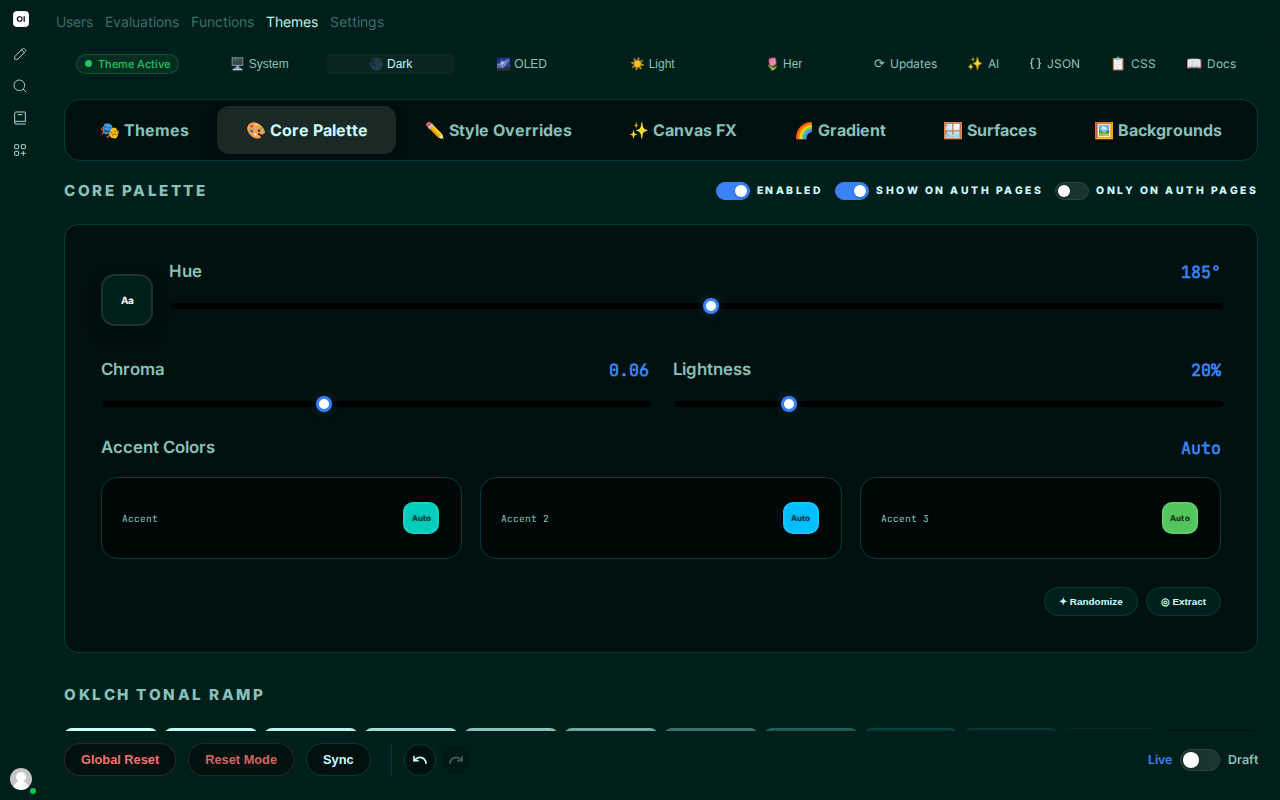
Show In Admin Panel on: a Themes page in the Admin Panel's top bar, with the designer in it.
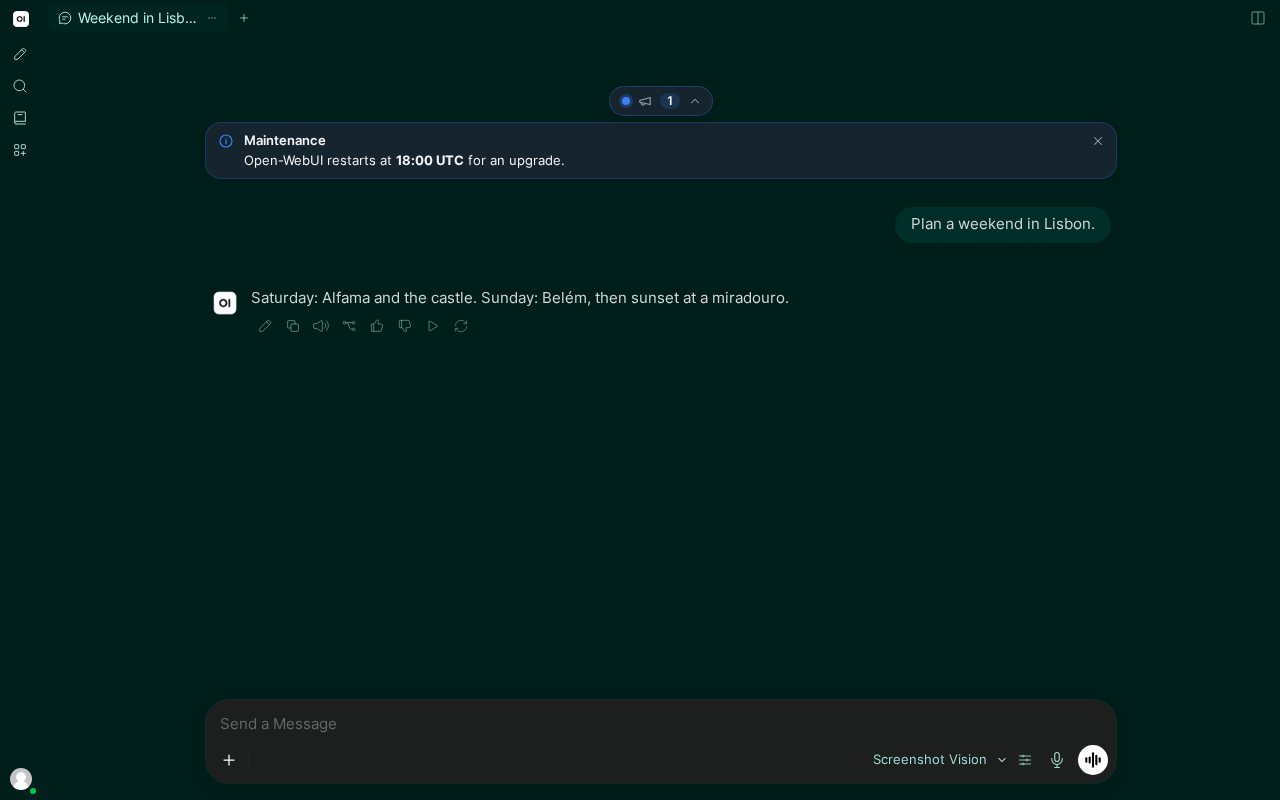
After: the function on and that palette saved; every page, this chat included, wears it from its first paint.
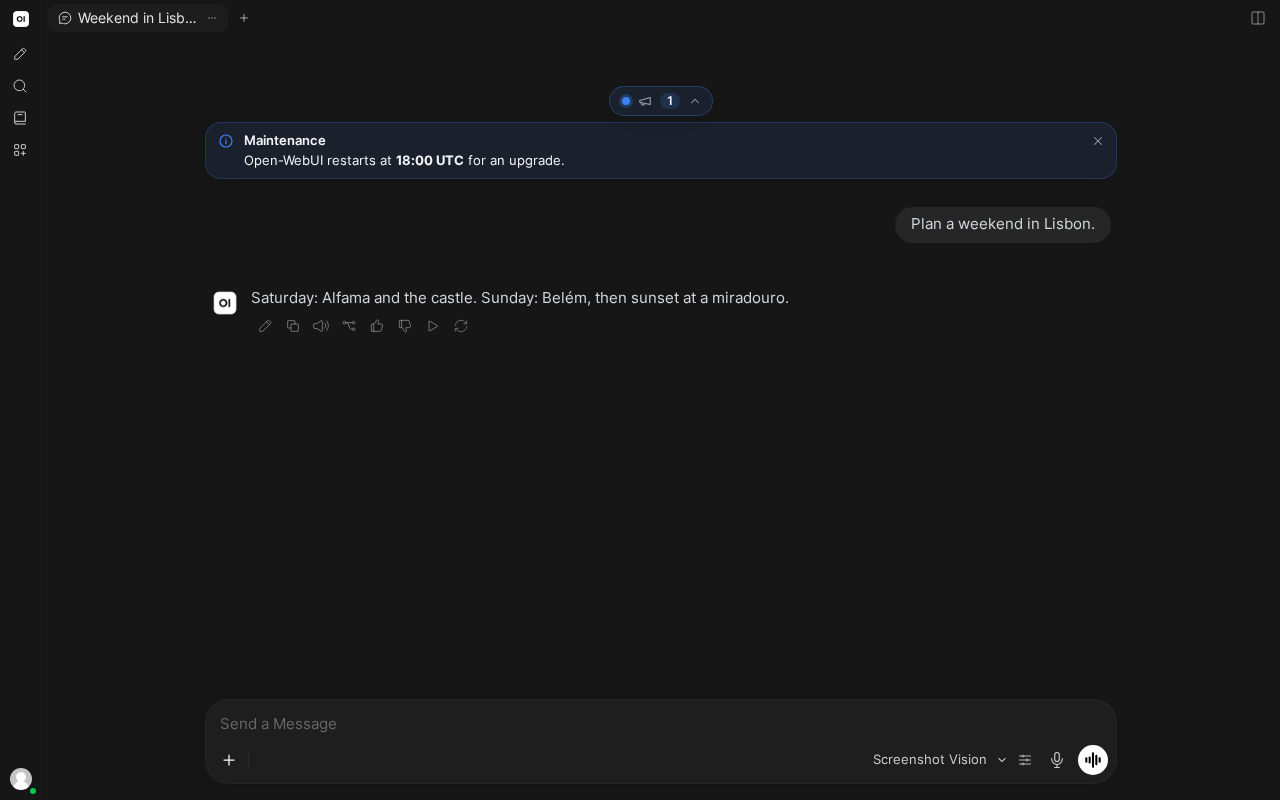
Before: the function off, a chat in Open-WebUI's own dark theme.
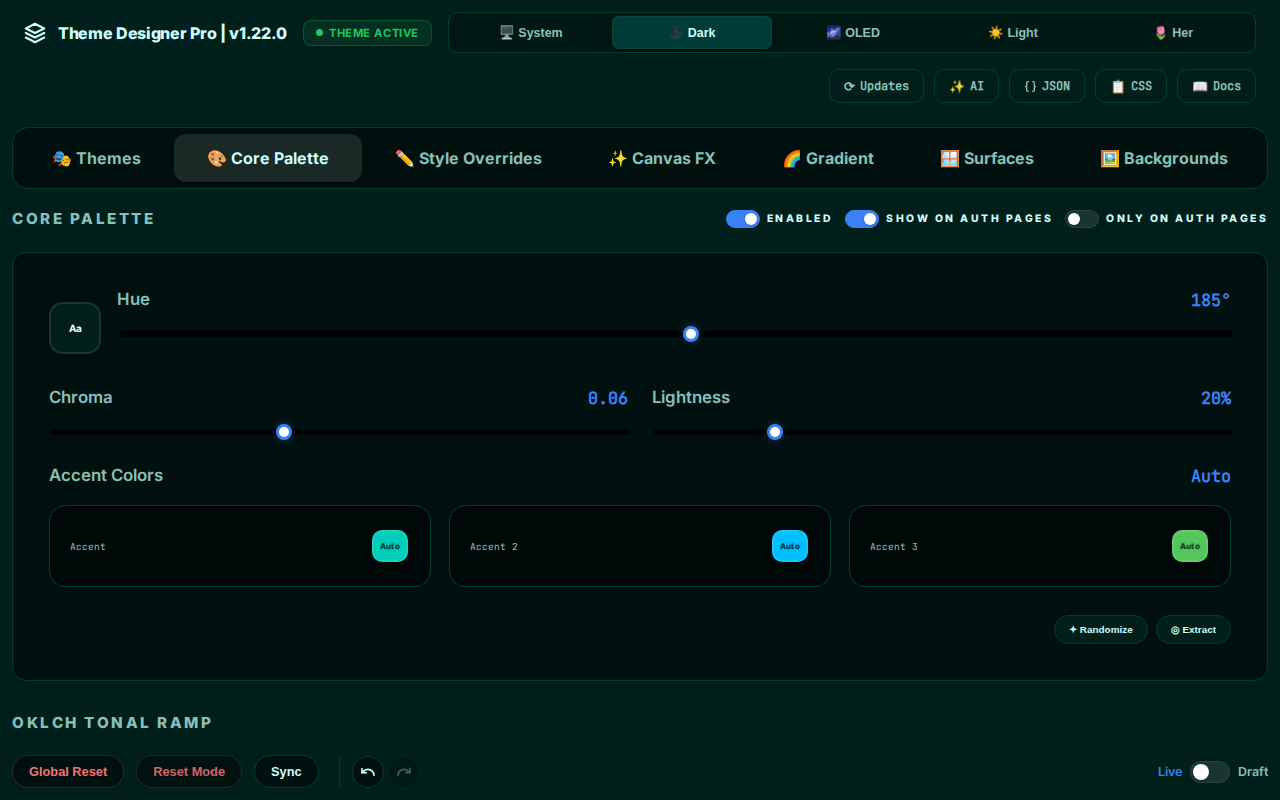
The designer's Core Palette tab, after moving Hue and Chroma: the ramp of Open-WebUI's greys it makes, saved for everyone at once in Live mode. The page is templates/designer/, put together from thirty files.
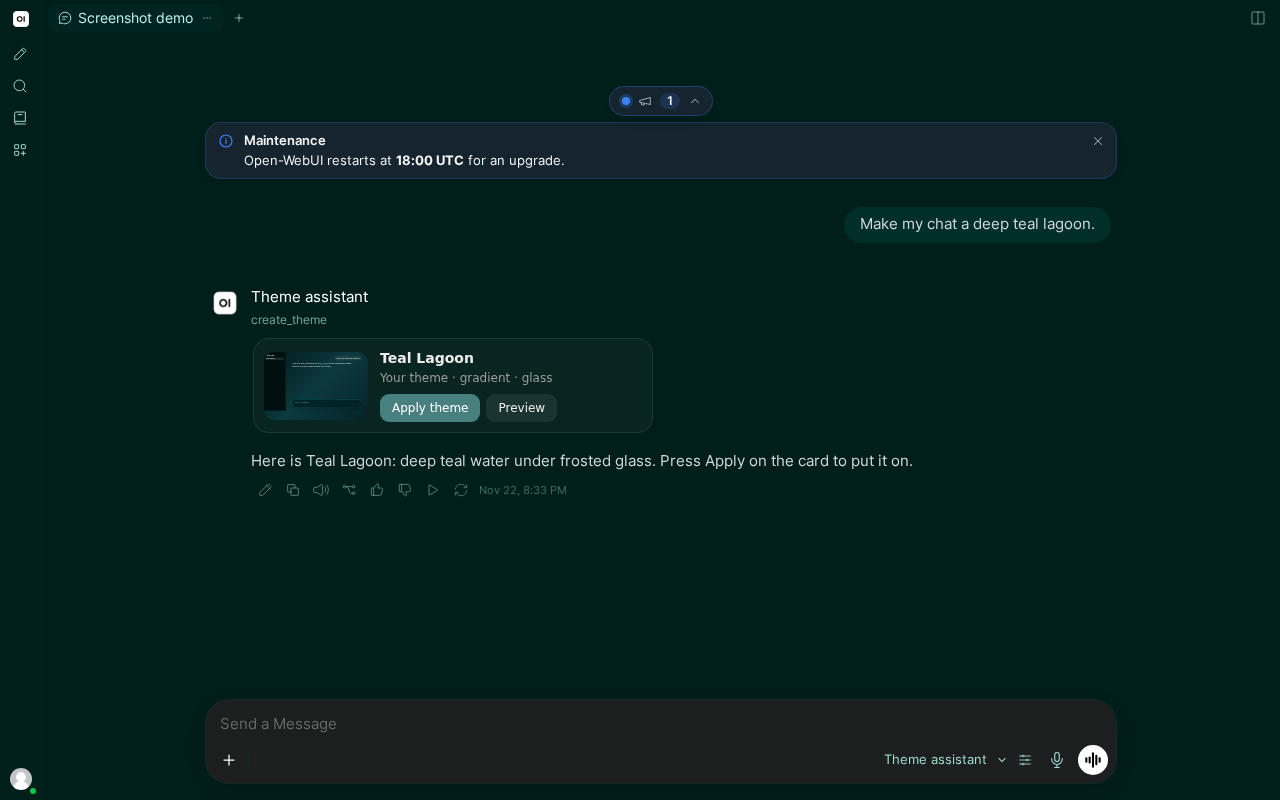
The model called the Launcher's create_theme; its card shows the theme with a live preview, and Apply signed for this user only.
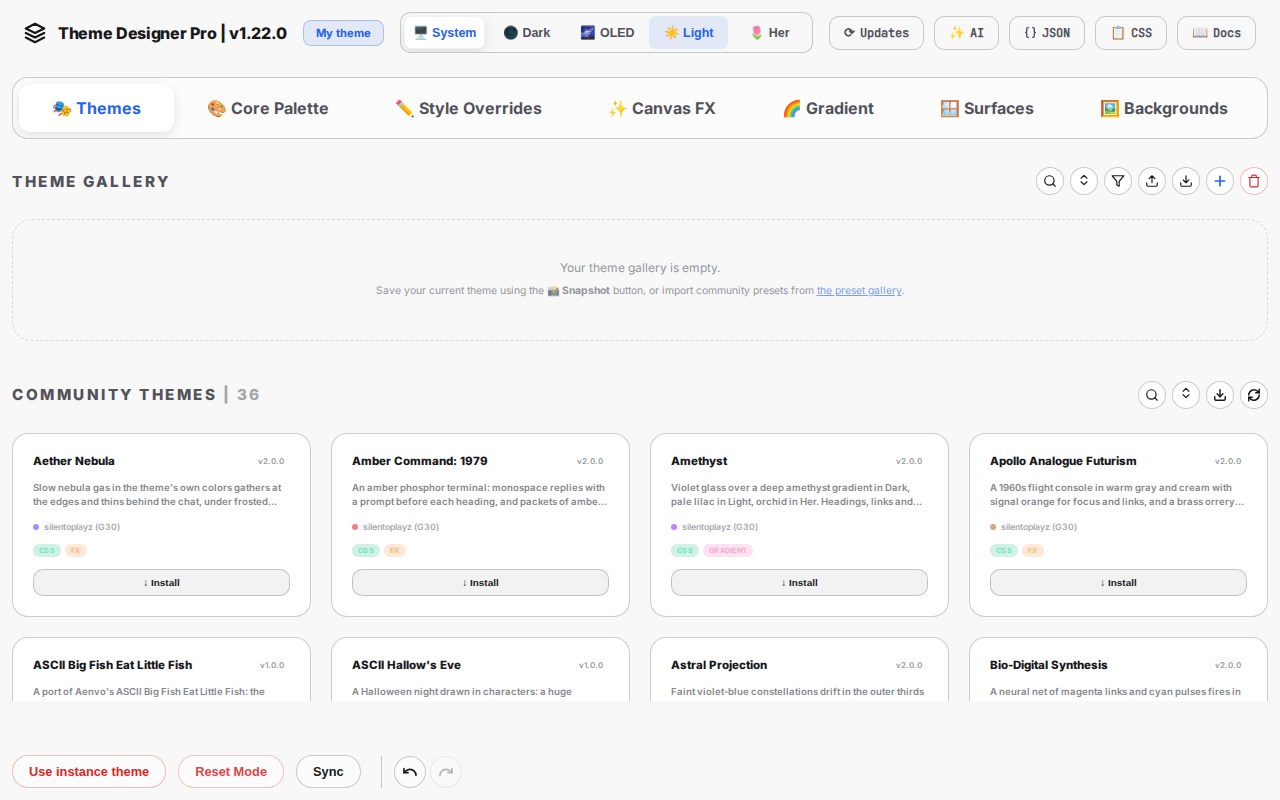
With Allow Personal Themes on, a user's own designer, starting from the instance theme: the instance-only controls are gone, and saves change only their theme.

Personal themes off (the default): a user's designer link answers with a sentence.
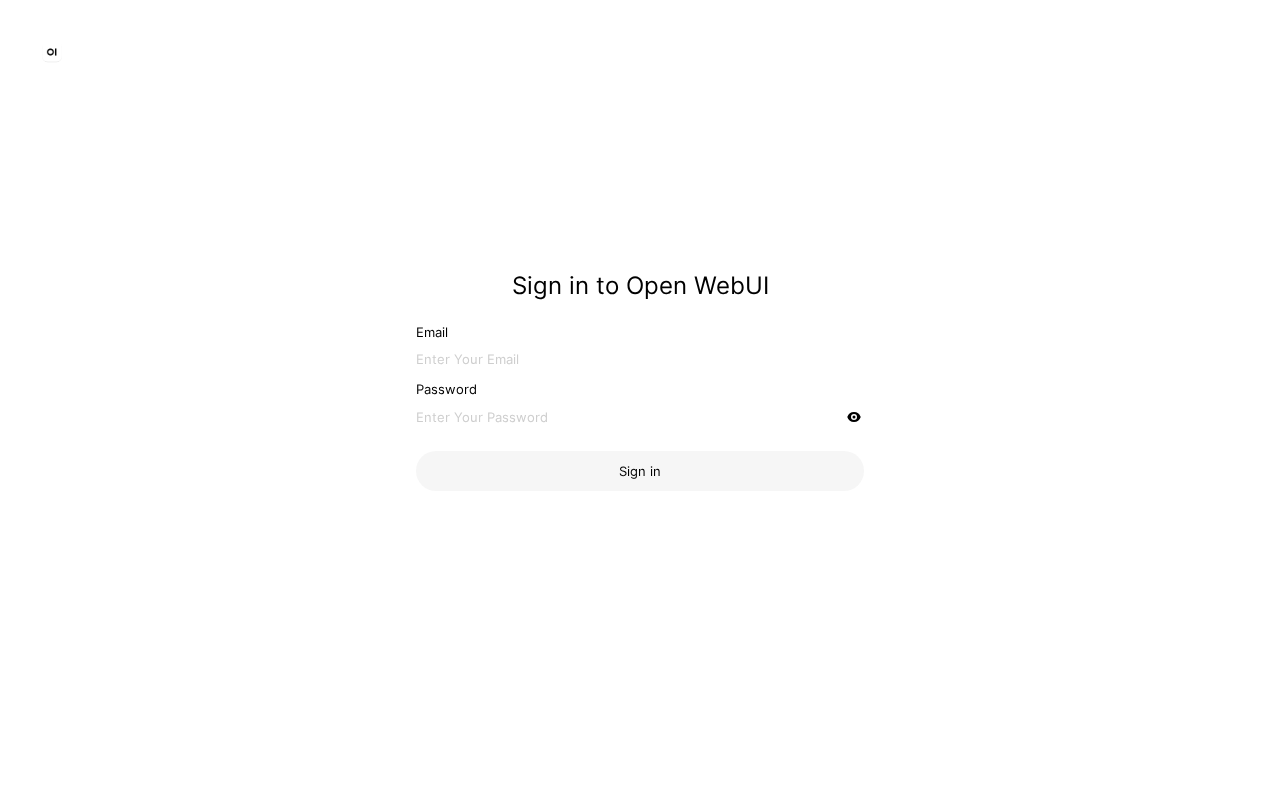
Signed out, owpp's guard sends the designer's visitor to Open-WebUI's sign-in page.